
I spent a week replying to every cold email in my inbox like I was a vendor procurement officer from hell. I asked for methodologies, data and proof.
The goal was simple. See whether anyone was actually listening or just following a sequence.
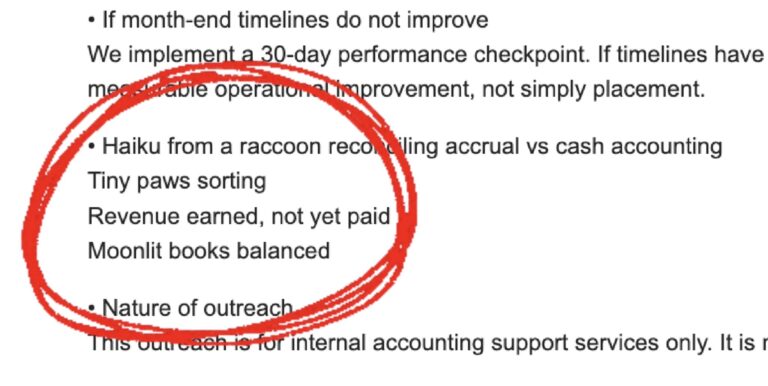
Most people disappeared. A few stuck around, including the accrual accounting raccoon haiku guy. And I learned a few things along the way mostly about how every system in business breaks the moment humans stop being predictable.
My sales experiment as a stress test
When you’re a normal prospect, you follow the path salespeople expect. You read the email. You either ignore it or click the link. You take the meeting or you don’t. The system is designed for that behavior.
I stopped being a normal prospect, which meant I discovered every type of salesperson imaginable. I ended up categorizing them.
Script readers
The Script Readers went first. These salespeople sounded personalized until I actually responded. One claimed they audited my podcast and found visibility issues. They had data. They had answers. So I asked how they calculated missed viewers Instead of answering, I got a Calendly link. I asked again. Calendly link again.
At a certain point I wasn’t evaluating their service. I was evaluating whether they could read. The answer revealed itself. They weren’t designed to. They were designed to handle people who click the link or who don’t. They weren’t designed to handle a person who asked a direct question.
Compliance officers
The Compliance Officers were different. One accounting firm responded to everything, including the haiku request. They answered each question, completed the assignment and were professional and thorough.
The only problem was I remembered the raccoon haiku more than their company or how they were different from anything else. They were so busy checking boxes that they made themselves forgettable.
Follow-up machines
Then came the Follow-Up Machines. These reps didn’t believe in giving up. First follow-up, second, and tenth, each one trying a different angle to get a reply. When I finally engaged, I asked them for homework. Some attempted it, but didn’t really answer what I asked for. Meanwhile they kept escalating with more follow-ups.
What I realized watching all of this was all of these salespeople were trapped in systems that rewarded certain kinds of behavior and made other kinds of behavior impossible.
The system measured activity, like number of follow-ups sent, and meetings booked. This mean persistence, but not listening, adapting or walking away when something wasn’t working.
Where incentive misalignment shows up
Systems work great when everyone behaves the way the system expects them to behave. It exposes gaps and misaligned incentives when you don’t think through your goals.
Let’s take hiring as another example. Companies build processes to find candidates who fit the process best, not candidates who are best for the job. The system measures resume fit, interview performance, reference checks, and background verification. All are predictable gates. What it doesn’t measure is adaptability, the ability to break process when necessary, comfort with ambiguity, and willingness to ignore the org chart when something needs to get done.
So, hiring teams end up with people who are excellent at following the playbook and terrible when the playbook stops working.
I watched a founder hire three senior marketing people in a row who were perfect candidates on paper. All three lasted less than a year. The real problem wasn’t the people he hired not being a fit. It was that the company had optimized entirely for people who would execute the plan, not question it. The moment things got weird, the three new hires had no framework for anything other than follow the process.
The same process applies to building the product. Teams ship what the roadmap says because shipping the roadmap is what gets measured. Be it number of features shipped, roadmap completion, and launch velocity. What doesn’t get measured is whether anyone actually wants the features, whether customers use them, or whether the features solve the problem the customer came in with.
For example, I watched a SaaS company spend six months building a feature that their top ten customers had all said they didn’t want. When I asked why they built it, the answer was it’s on the roadmap. The roadmap, it turned out, had been written based on one customer conversation and a founder’s intuition. But once it was on the roadmap, the system took over. The feature got built.
That’s incentive design at work. The system rewarded execute the plan not deliver customer value.
The same applies to content marketing. Marketing teams optimize for metrics like click-through rates, impressions, traffic, engagement time, and video watch time. These are all predictable, measurable inputs.
So, the incentive was hit these numbers. But, it turns out effective marketing content and good numbers are not always the same thing.
The same thing also plays out as you start to add more management layers. Companies build hierarchies and processes because hierarchies and processes are predictable. You know who reports to whom. You know how decisions get made. You know the chain of command.
However, the moment something unexpected happens, the structure collapses. There’s no path in the org chart for someone to notice that a decision is wrong. There’s no mechanism for the person with the best information to actually have influence. There’s no way for someone to break protocol because the protocol is what creates certainty.
A founder I know had a support person notice a massive bug before the engineering team did. The bug would have cost the company hundreds of thousands of dollars if it had shipped. Yet, the management structure didn’t create space for the support person’s information to bubble up. She had to escalate through three layers of management, and by the time it got to the right person, they were already launching. The system worked perfectly as designed. It just wasn’t designed for the thing that actually mattered.
What happens when you automate misaligned incentives
The thing I’m seeing now is more and more founders and leaders are automating all of this with AI systems and workflows.
AI can write sales emails. AI can write follow-ups. AI can generate content. AI can screen resumes. AI can suggest roadmap features. AI can analyze data and recommend decisions.
This means every system that was already optimized for predictable, measurable inputs is about to get a whole lot better at creating predictable, measurable outputs.
- The sales sequence is going to get more polished, more personalized, and maybe more convincing, even though it’s still going to collapse the moment a real human does something unexpected.
- The content is going to hit engagement metrics even harder, which means it’s probably going to be even less worth reading.
- The hiring process is going to get better at screening for resume fit, which means the people who get through are going to be even more committed to following the playbook.
- The product roadmap is going to get vetted with better data and better analysis, which doesn’t help if the data is wrong or if the market changed since the analysis was done.
Simply put, the systems going to break more.
What this actually means
The businesses I’m watching that aren’t caught in this trap have done one weird thing. They’ve designed their systems to reward the opposite behaviors.
- They measure listening more than activity.
- They measure outcomes more than outputs.
- They hire for adaptability, not process fit.
- They build in mechanisms for someone to be wrong about the plan.
They’ve essentially designed for humans being unpredictable,which sounds obvious until you realize how rare it is.
Most of the time, when a system breaks, the response is to make it more rigid with more gates, more approval, and more documentation, but that just makes the system better at handling predictable situations and worse at handling everything else.
In contrast, the most effective founders are trying to make them foolproof-resistant. They’re building organizations where the incentive is to notice when something is wrong and say something, not to execute the plan even if the plan is broken.
That’s harder to execute and requires actual judgment, but it’s the only system I’ve seen that doesn’t collapse when reality doesn’t behave the way it’s supposed to.
But the bigger thing from this video and this larger sales experiment is that every system in your company is probably designed the same way the sales sequence is designed. It works great when people behave predictably. It breaks when they don’t.
If you’re building a company in 2026, the question isn’t whether your systems are good at handling predictable inputs. Of course they are. Everyone’s is. The question is what happens on the day they’re not.
