
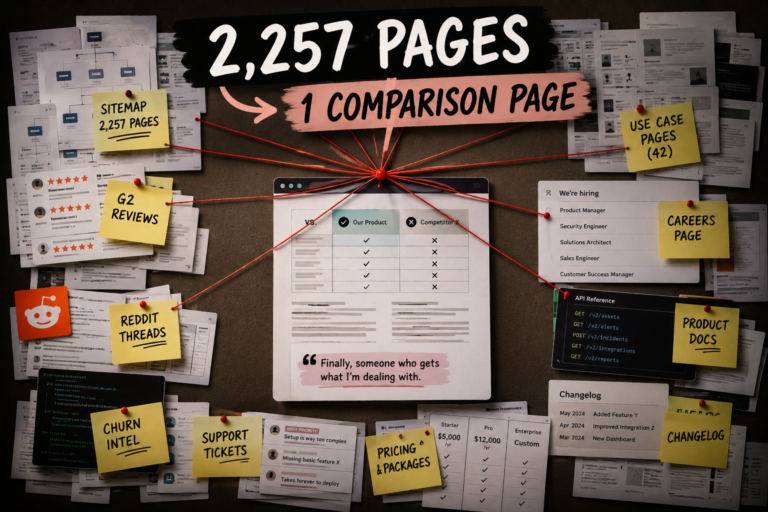
I scraped 2,257 pages of a competitor’s website to write one comparison page.
Here’s the decision tree I use to consistently outrank larger competitors on Google, get cited by LLMs, and drive more paying customers for clients, and why most AI-generated comparison pages don’t rank or convert.
What is comparison page copywriting?
Comparison page copywriting is a specific category of conversion copywriting. The deliverable goes by different names (i.e. vs page, alternative-to page, comparison table, etc) but the job is the same. Write copy that makes a frustrated competitor customer feel seen before your product ever enters the frame. That requires research most copywriters skip.
Step 1: Scrape the full sitemap, not just the homepage.
The homepage tells you what they want you to think. The sitemap tells you what they’re actually betting on.
Now, I’ve written and published over 250 comparison pages for B2B companies in the last five years. In this post, I’m going to share an example of my process for one of them. In this case, it is for a B2B SaaS company in the IT vertical.
When I scraped one of their many competitors, I didn’t lead with their homepage headline. I looked at their URL structure, post sitemaps, 42 dedicated use case pages, a separate OT product track and even in their careers page (as the roles that they are often hiring for today can be a good indicator of their roadmap over the next 3-6 months).
That’s a strategic map of where they’re putting money and attention. It tells you which pages to actually read and which 232 out of 2,257 are worth your time.
Step 2: Cross-reference with G2, Capterra, and Reddit before you write a single word.
The sitemap tells you what the competitor claims. G2 reviews tell you what their customers actually experience. Those are different documents.
The frustration layer is where comparison page copywriting lives. When a competitor’s customers keep saying setup requires infrastructure their team doesn’t have or it takes forever, that’s an FAQ answer in your comparison page and another objection killer. That’s the line that makes a frustrated prospect feel seen.
Reddit threads and churn intel are the same deal. If you skip this step the page is accurate. It’s just not sharp.
Step 3: Extract the strategic observation, not the feature list.
Sometimes, the biggest competitor market research is how a competitor names their product category. So for the anonymized example above, this competitor renamed their entire product category “Cyber Asset Intelligence” because it lets them live in two budget lines simultaneously: IT ops and security. That’s a go-to-market move.
That observation takes 30 seconds to write. It takes years of pattern recognition to notice.
Step 4: Write the comparison table with a lawyer in your head.
This is where most AI-assisted comparison pages go sideways. Three ways it happens:
You mark a competitor’s feature as X and it’s wrong. They added it six months ago. Now, you have a false claim on a public page and a competitor’s legal team has a screenshot.
You write a table so generic that a skeptical buyer immediately clocks it as AI slop. They don’t trust the page or your product.
You accidentally write the competitor’s value prop better than they do. I’ve seen this happen. The “What is [Competitor]?” section is so fair and thorough that the reader thinks actually that sounds great and bounces.
Step 5: Run it through a content grading skill before it ships.
I built a decision tree into a Claude skill that grades every page I write against the same criteria. This helps me reduces overthinking, keep quality consistent, and catch the stuff I miss when I’m too close to the draft.
Most comparison pages are written by someone who spent 20 minutes on the competitor’s pricing page.
You can tell.
The table is generic. The FAQs are fake. The honest comparison isn’t honest. It’s just your product wins every row and nobody believes it.
I’ve written hundreds of these. The ones I wrote that actually convert are the ones where a frustrated competitor customer reads the FAQ and thinks: finally, someone who gets what I’m dealing with.
That requires research. If you want to build this workflow yourself, everything above is the framework.
If you’d rather just have the page done right: book a call.
FAQs
Does this process apply to vs pages and alternative-to pages?
Yes, with one difference. Alternative-to pages have less legal exposure because you’re not naming a competitor in a direct head-to-head. You’re positioning against a category. Vs pages are the highest-stakes version since you have a named competitor, public comparison, and every claim is a potential liability if it’s wrong. The research process is identical. The legal filter in Step 4 just gets tighter.
What makes comparison page copywriting different from other conversion copywriting?
It’s mostly the research requirement and the legal dimension. Standard conversion copywriting is about understanding your buyer. Comparison page copywriting is about understanding your buyer, your competitor’s product, and your competitor’s legal team simultaneously. A landing page that gets something wrong about your own product is fixable. A comparison page that marks a competitor’s feature as unavailable when they shipped it six months ago is a false claim on a public page. The stakes are different.
How do you handle competitor sitemap analysis if the site doesn’t have a public XML sitemap?
Crawl it. Tools like Screaming Frog will map a site structure even without a sitemap file. You’re looking for URL patterns, not metadata. The structure of the URLs tells you what the company is betting on. For instance, /use-cases/ versus /integrations/ versus /customers/ are different strategic signals. The sitemap file just makes it faster.
How long does competitor analysis for copywriting actually take?
For a single competitor, budget 3-5 hours of real research before writing anything. That includes the sitemap analysis, 50+ reviews on review sites across rating tiers, some relevant Reddit threads, and identifying the strategic observation. If you’re doing this for multiple competitors, which most comparison pages require, multiply accordingly. Anything under two hours is surface research. You’ll be able to tell, and so will your buyer.
Do short comparison pages still convert better? Do short or long comparison pages convert better?
It depends on what the buyer needs to justify the switch. Short pages work when the decision is simple, such as same category, obvious feature gap, and low switching cost. Long pages work when the buyer has to convince someone else. If a VP needs to approve the migration or a procurement team needs to sign off, the page has to do the selling they can’t do in a Slack message. In practice, if your product costs under $200/month and installs in a day, shorter is fine. If it requires onboarding, migration, or a contract, the FAQ and the table need to be thorough enough to survive a procurement review without you in the room.
